
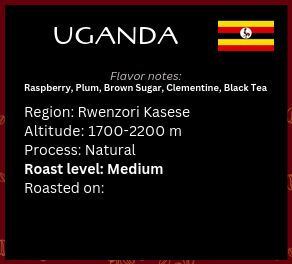
Uganda Rwenzori Kasese, SL-14, SL-28; Natural
"Raspberry, plum, brown sugar, clementine, black tea."
Rwenzori Mountains: "Mountains of the Moon"
Rising along the border of the Democratic Republic of Congo, the Rwenzori mountains - also known as the Mountains of the Moon - form one of Uganda's most dramatic coffee landscapes.
Within this range lies Kasese--a district whose high-altitude communities cultivate exceptional Arabica in fertile volcanic soils and cool, misty microclimates. The region long served as a lifeline crop for rural households, and today it is rapidly becoming one of Uganda's most celebrated sources of high-quality natural coffees.
How is coffee graded in Ethiopia?
In Ethiopia, coffee is graded on a scale from Grades 1 to 9, with Grades 1 and 2 signifying top-tier specialty coffee, assessed through both physical attributes—such as size, shape, color, and defects—and cup profile, focusing on aroma, flavor, acidity, and body. Coffees are further classified by their region of origin, such as Sidama, Guji, or Yirgacheffe, whose unique terroirs greatly influence flavor profiles. Processing methods, such as washed or natural, also play a role in shaping the coffee's final characteristics and quality grade.
About Kasese Region Coffees
Coffee has become one of the most economically significant crops in Kasese, grown across nearly all sub-counties and providing vital income for rural farmers. The area's high elevation - over 1,200 meters - cooler temperatures, and abundant rainfall create ideal conditions for slow-maturing Arabica, with pronounced sweetness and complexity.
After selective picking, fresh cherries are delivered to Kyagalanyi's mill, where they undergo natural processing. Coffee cherries are sun-dried on raised beds with the fruit intact. Regular turning encourages even drying and prevents over-fermentation. Natural processing at high altitudes gives this Rwenzori lot its signature smooth, aromatic profile, while honoring the region's longstanding traditions.